
The basics are easy. Nearly every laundry service handles your normal weekly laundry without a problem. However, first-time customers often hesitate because they’re unsure how these services handle delicate fabrics, workout clothes, dress shirts, or garments with special care instructions.
If your laundry pile includes more than just basic T-shirts and towels, the more worth your while it is to understand exactly how the service handles it. This guide explains what full-service laundry actually covers, how garments move through the process, and which items you may want to separate, flag, or handle differently from the start.
What Goes Into a Wash and Fold Order (and What Doesn’t)
What Items Can Go into a Wash and Fold Laundry Service?
Most everyday laundry items are perfect for Wash and Fold Laundry Service, including:
- T-shirts, jeans, and shorts
- Underwear, socks, and everyday basics
- Casual tops, pajamas, and activewear
- Gym and workout clothes
- Sheets, pillowcases, and towels (if accepted)
What Items Need Special Care?
Some garments require separate handling and shouldn't be included in a standard wash and fold order, including:
- Suits and structured blazers
- Silk blouses and cashmere sweaters
- Dry clean only garments
- Items with heavy beading or embellishments
- Anything labeled "Hand-Wash" or "Lay Flat to Dry"
The most important thing first-time customers miss: if a special-care item slips into a wash and fold bag without being flagged, it can get processed on the standard cycle. That’s not negligence, it’s how volume laundry operations work. Reputable services give you a way to flag garments at intake, whether that’s a note in your bag, a field in their app, or a quick call. Use it.
For Portland households specifically, this step matters more than most. A single wardrobe here might include a DWR coated rain shell, a merino wool base layer, a graphic tee from a local artist, and a blazer for a client meeting, all in the same laundry pile. Not all of these belong in the same order.
How the Sorting, Washing, and Drying Steps Actually Work
This is where a professional Wash and Fold Laundry Service earns its edge over the home machine.
Sorting
Every order gets sorted by color, fabric type, and wash temperature before anything gets wet. Darks, lights, and colors are separated. Delicates are pulled from the main load. Heavy items such as towels and denim don’t get tossed in with lightweight fabrics.
Most people skip this step at home because it takes time. Professional services do it on every order, and that consistency shows in how your clothes hold up over time.
Washing
Commercial machines run at calibrated temperatures matched to each fabric type. Cold water for darks and colors. Warm for most everyday cotton and synthetics. Specific temperatures for anything flagged as delicate. Load sizes are also optimized for cleaning performance, not for cramming in as much as possible.
If you’ve ever pulled a shirt out of a home load that somehow came out less clean than it went in, oversized loads and wrong water temps are usually the culprit. The cold water processing for colored garments is worth calling out specifically. Consistent cold washing is one of the main reasons professional laundry preserves color and vibrancy better over time.
Drying
Commercial dryers run at controlled temperatures matched to fabric type. Most services also offer air drying for items where heat causes shrinkage or damage, but this has to be flagged at drop-off.
The Folding and Return Step
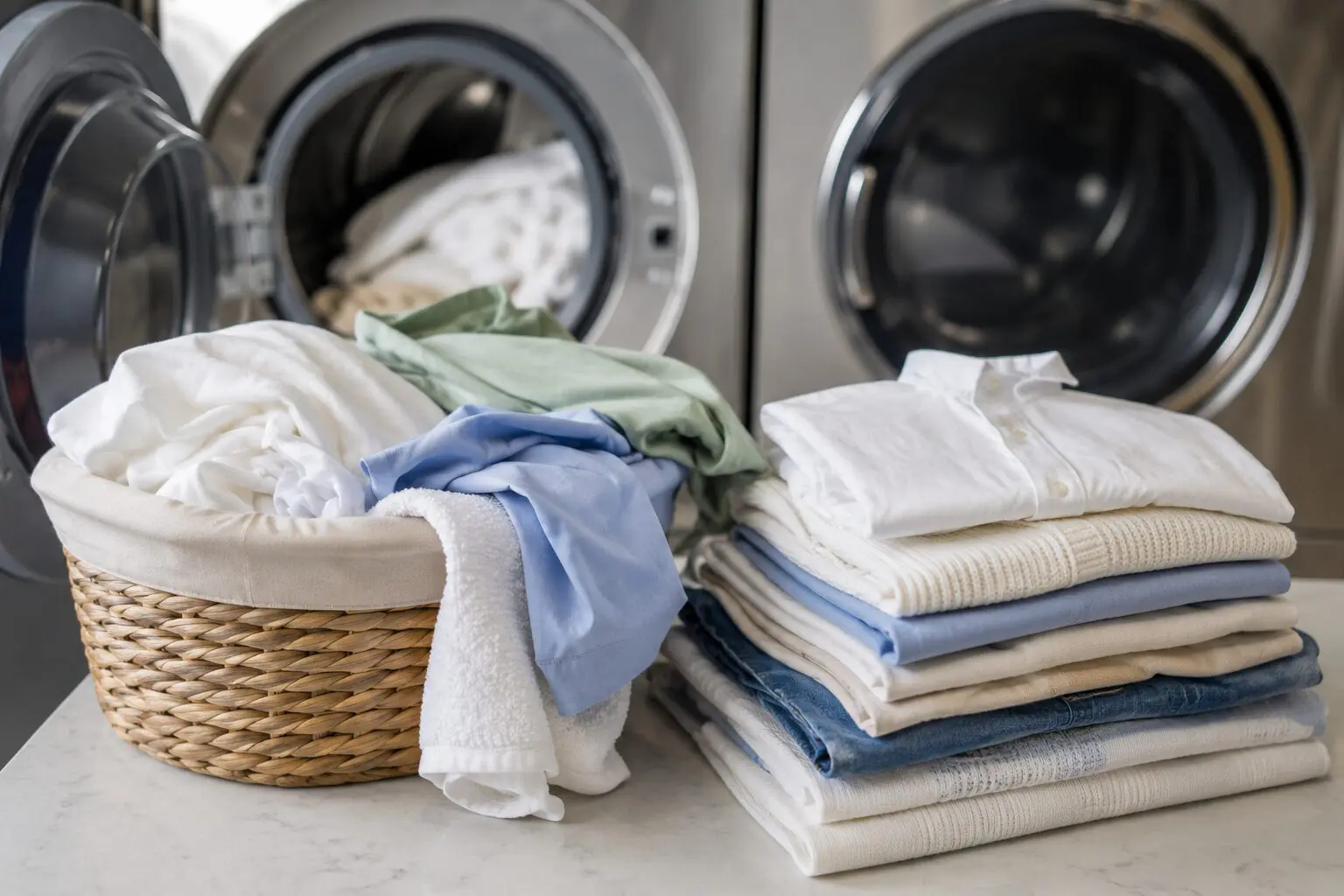
When your order comes back, here’s what to expect: clean clothes and home essentials, folded consistently, organized by type. Shirts together, pants together, socks paired. It’s tidy and practical.
What isn’t included in most wash and fold services: pressing or ironing garments to a work ready finish. Wash and fold produces clean, folded laundry ready to go into a drawer. It does not produce pressed dress shirts or creased trousers.
That’s a separate service, typically a pressed shirt or dry cleaning order. This is the most common first-order disappointment, and it’s easily avoided by knowing the distinction going in.
To put it plainly:
- Expecting pressed, work ready shirts from a wash and fold order? You’ll be disappointed.
- Expecting clean, organized laundry back at your door without spending your evening at a machine? You’ll be satisfied.
Packaging varies by service. Most return items in a bag organized by order. Some use tissue paper or offer separation by family member on request, worth asking at intake if that matters to you.
What Happens With Garments That Need Special Handling
A good laundry service doesn’t just wash everything the same way and hope for the best. Here’s what proper special-handling looks like at each stage:
At intake
Reputable services check care labels on all items and route anything flagged as delicate, dry clean only, or hand-wash separately from the main cycle. Before your first drop-off, ask directly: how does this service handle items with special care requirements? A clear, specific answer is a good sign. Vague reassurance is not.
For dry clean only items
These should not go into a wash and fold bag at all. Submit them as a separate dry cleaning order. Many full-service laundry providers offer both. Ask whether combined drop-offs are possible and how items are physically separated at intake.
For Portland wardrobes specifically
A few garment types come up often in this city:
- Technical jackets and shells with DWR (durable water repellent) coatings need careful handling to preserve their performance
- Merino wool base layers require low heat and gentle cycles
- Structured wool pieces can felt or distort if processed incorrectly
A service that handles these correctly will have specific protocols for each type. Ask about your particular garment types on the first visit.
The clearest sign of a trustworthy laundry service: they contact you when a care label is missing or unreadable, rather than processing the item on the standard cycle and hoping it turns out fine.
From the First Wash to the Final Fold, CC Clean Handles Every Step
Full-service laundry care gives you more time back in your week while ensuring your clothes and household items stay consistently fresh, clean, folded, and ready to use. At CC Clean, our Wash and Fold Laundry Service is built for busy households, working professionals, families, and light commercial clients who want dependable laundry support, transparent pricing, eco-friendly operations, and reliable turnaround times they can count on.
Stop spending your free time sorting towels and folding clothes. Schedule your Pickup and Delivery Service with CC Clean today, save 20% on your first order, and get clean, organized laundry back at your door on a schedule that works for you.
Contact CC Clean today, or schedule your Wash and Fold Laundry Service online.
Contact Guide:
📍 3450 N. Williams Ave., Suite 3, Portland, OR, 97227, United States